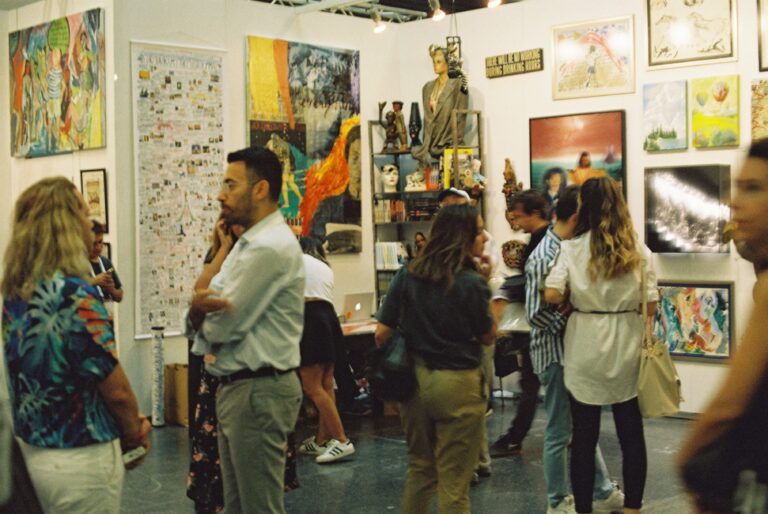
Six hundred events in a Welsh market town. What Hay 2026 was really selling was an hour of undivided thought.
21–31 May 2026 · Hay-on-Wye, Powys
Hay Festival’s chief executive describes it as “part Glastonbury, part Davos”, which is the best description of anything I have read this year. Eleven days. Six hundred events. A field in Wales, a great many tents, and the reliable Welsh rain.
And in the middle of it, thousands of people were voluntarily sitting still for an hour, with no screen, listening to one person think aloud.
What was covered
The thirty-ninth Hay Festival sprawled across politics, fiction, science, comedy and climate, on a dedicated site just outside the Town of Books.
Simon Armitage, the Poet Laureate, opened the festival with poetry. Ian McEwan discussed his new novel with Julia Gillard. Malala Yousafzai spoke about being thrust onto a public stage in adolescence. Bernardine Evaristo talked about multigenerational families and complicated women; Elizabeth Strout, that trick of hers of making characters feel like relatives. Val McDermid brought a thriller. Nicola Sturgeon brought a memoir and, one assumes, some opinions. Mariana Mazzucato brought economics, David Miliband brought geopolitics, and Mary Berry, Michael McIntyre and Sandi Toksvig brought the rest of the country.
Strands ran on the climate emergency, on voices from the Global South, and this being the year of America’s 250th birthday, on the fiction, history and politics that built the American idea. The lecture series led with names such as Christopher Hitchens and George Alagiah.
And Katherine Rundell gave what I suspect was the most quietly radical talk of the week: on the power of reading for pleasure, in an age of artificial intelligence.
What a festival of ideas is actually for
Here is the thought I could not shake.
In 1971, the economist Herbert Simon observed something that has only grown truer since. A wealth of information, he said, creates a poverty of attention. Information was becoming abundant; the capacity to attend to it was not. Therefore, attention, not information, would become the scarce and valuable thing.
Consider what that means now. We are the richest people in history in terms of text. Every book ever scanned, every argument ever made, and now machines that will summarise, paraphrase and generate more of it on request, endlessly, for nothing.
The one thing that has not become cheaper is a human being’s sustained attention. It remains stubbornly finite, roughly sixteen waking hours a day, non-transferable, non-scalable.
Which is why at the field in Powys, they requested six hundred hours of undistracted sessions, which is not considered nostalgic indulgence. It is, whether it knows it or not, a rebellion against the economics of everything else. Nobody is optimising for your engagement. Nobody is serving you a shorter version. You sit down, and you think at the speed a human thinks.
The reading question
Which is what made Rundell’s subject so pointed. If a machine can produce a passable essay in nine seconds, why should any of us labour through a difficult book?
The answer is not that machines write badly. It is that reading was never primarily about acquiring the information at the end of it. Reading a hard book changes the mind slowly. You cannot outsource that any more than you can outsource going to the gym. The summary is not the thing. The summary is a photograph of the thing.
I would say precisely the same about money, incidentally, which is my usual beat. You can be handed a conclusion buy this, avoid that and it will do you no good whatever, because you will not know why, and so you will not know when the reasoning stops applying. The understanding is the asset. The conclusion is merely its receipt.
Should you go?
The site is free to enter. Individual talks are ticketed, and the popular ones sell out months ahead. There is a bookshop, signings, and a very large marquee for children.
If you go, my advice is unfashionable: attend fewer things. Three sessions and a long lunch will lodge in you more deeply than nine sessions and a headache, which is, more or less, my entire philosophy of an afternoon. Buy one book rather than eleven, and actually read it. Collect the conversation, not the tote bag.
Hay returns from 27 May to 6 June 2027, and will be its fortieth, with almost four decades of people sitting in a wet field, paying attention on purpose. In the current century, it begins to look less like a literary festival and more like a form of resistance.
Educational commentary, not professional advice. What you read, and how slowly, is gloriously your own affair.
The Jacqueline Brand — knowledge builds confidence, and confidence builds wealth. This is editorial commentary for information and education only. It is not financial, investment or professional advice, and nothing here is a recommendation to buy or sell any investment. The Jacqueline Brand is not authorised or regulated by the Financial Conduct Authority. The value of investments can fall as well as rise, and past performance is not a guide to future returns. Figures were correct at the time of publication. Always do your own research and consider speaking to a regulated adviser. Where cryptoassets are discussed, they are high risk and largely unregulated in the UK, and you could lose all the money you invest. The Collection
© 2026 TheJacquelineBrand. All rights reserved. Please do not reproduce or republish without written permission.