March 21 – April 6, 2025 · Olympia, London
On the morning of the eighth of October, 1908, the Lord Mayor of London climbed into his coach, and through the city in full ceremonial splendour, sheriffs and aldermen trailing behind him, to declare open I promise I am not embellishing an exhibition of household articles. Not a palace. Not a parliament. Kitchen cabinets. Somewhere between the gold chain of office and the display of doorstep whitening lies a truth about this country so perfectly distilled that I have been quietly delighted by it ever since I discovered it, and it explains rather neatly why the Ideal Home Show is still with us more than a century later.
That first outing at Olympia gathered 366 exhibitors and 160,000 visitors; it was conjured up by Lord Northcliffe of the Daily Mail, partly as an advertising wheeze of quite magnificent cynicism and partly, and this is the part that moves me in a genuine spirit of social reform, to start an argument about how badly most people were housed. In 1908, ninety per cent of Britons rented. So the show arrived as a sort of campaign about what an ordinary life might reasonably look like, dressed in bunting, with a sideline in knife grinders.
A hundred and seventeen years of eavesdropping
What it has become since is the most complete record we possess of how Britain imagines itself at home, which is a considerably grander thing than a shopping trip has any right to be. The 1928 edition unveiled a House of the Future boasting pneumatic furniture, disposable cardboard crockery and a hangar for the family aerocar, a prediction I regret to inform you has not entirely come good. In 1960, the Douglas Aircraft Company erected a full mock-up of a space station in the middle of Olympia, and something like 150,000 people patiently queued to wander through a home in orbit before going back to their actual homes in Croydon. By 1957, the show was drawing nearly a million and a half visitors in a single run, at which point it had stopped being an exhibition and become a national day out.
Walk through its history, and you are watching aspiration itself change costume, from labour-saving gadgets to fitted kitchens, corner baths to conservatories, chrome and smoked glass to the smart home and the heat pump, each one arriving as the answer to everything and departing, in due course, as a thing your mother had. It has always been half shop and half mirror. The mirror, I’d argue, is the interesting half.
More work for mother
Which brings me to the idea I’d most like you to take away, because it is one of the great sly ironies of modern life. In 1983, the historian Ruth Schwartz Cowan published More Work for Mother, in which she pointed out something quietly devastating: all those glorious labour-saving devices, so many of them unveiled to gasps of admiration at this very show, did not actually save anybody very much labour. The washing machine did not hand anyone back their afternoons. What happened instead is that our standards rose smartly to fill the space, the way water fills a bath. Clothes, once washed weekly, were now washed daily. Floors that had merely been swept were now expected to gleam.
And this is not simply a historian being clever. The National Science and Media Museum, which holds the photographs from those very exhibitions, observes that after a century of gadgetry, we spend roughly the same hours on chores as we did a hundred years ago; the work is far less back-breaking, there is just as much of it, and women are still doing more of it than men. In 1957, the average British housewife spent seventy hours a week on housework, which is to say rather more than a full-time job, without the pension. Do bear that in mind the next time a beautifully lit appliance promises to give you your life back. Technology is marvellous at changing the nature of the work. It has never once, on its own, changed who ends up doing it.
What it’s for now
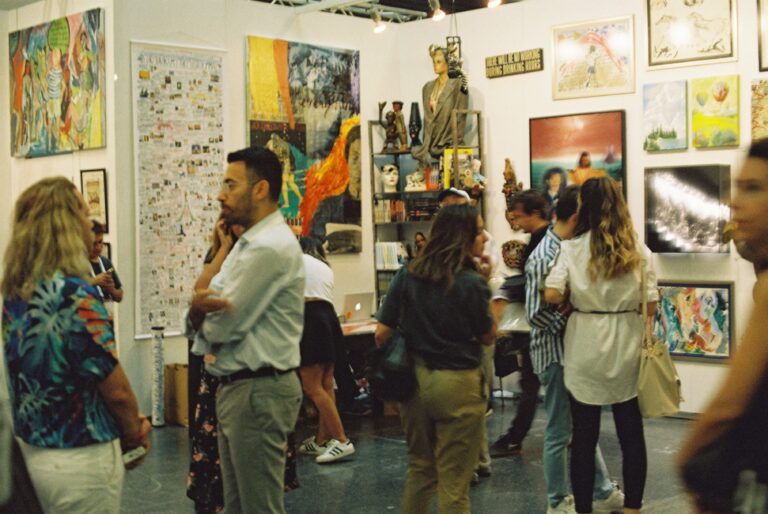
So what should we make of the modern show, sprawling across a fortnight and a bit each spring? Let me be straight with you, because I’d rather you went with clear eyes. It is a shopping event. Hundreds of brands fill the halls across zones to interiors, renovation, gardens, kitchens, decluttering, food and drink; there is a full show home built inside the building, and experts hold forth on the stages from morning till closing. Nobody is there in a spirit of social reform any more, and the family aerocar has been quietly replaced by a very well-positioned mortgage advisor.
And yet I’d defend it, warmly and without much hesitation. There is genuine value in seeing a material with your own eyes rather than through the flattering fiction of a photograph, in laying your hand on a worktop before committing several thousand pounds to living with it, in comparing six versions of the same tap in a single afternoon and discovering that you have opinions about taps. The breadth is the whole point, since it serves the woman gutting an entire house and the woman who wants one room to stop annoying her every time she walks in. And in an age that sells us our homes through a phone screen, an event that insists you turn up, look properly and touch things feels almost charmingly subversive.
How I read it
I keep coming back to that Lord Mayor, processing solemnly toward a hall full of coal scuttles, because he understood something we’ve rather mislaid. Our homes deserve to be taken seriously not as showrooms to be photographed and admired by strangers, but as the places where our one actual life is spent. That was the founding instinct in 1908, and beneath all the gadgetry and the mortgage advisors, it has stubbornly survived.
What has changed, and what Cowan should make us cheerfully sceptical about, is the promise. No appliance will give you back your afternoons; only choosing differently will do that. So go, by all means. Enjoy it, gather ideas, touch the worktops, buy the one thing you love and leave behind the eleven you don’t. And do remember that a home is not a project to be finished but a place to be lived in, a realisation that costs considerably less than most of what’s on sale, and lasts a great deal longer.
This is me, thinking out loud in your company, a look at a very old show, not professional advice. What you do with your own four walls is gloriously your own affair.
The Jacqueline Brand — knowledge builds confidence, and confidence builds wealth. This is editorial commentary for information and education only. It is not financial, investment or professional advice, and nothing here is a recommendation to buy or sell any investment. The Jacqueline Brand is not authorised or regulated by the Financial Conduct Authority. The value of investments can fall as well as rise, and past performance is not a guide to future returns. Figures were correct at the time of publication. Always do your own research and consider speaking to a regulated adviser. Where cryptoassets are discussed, they are high risk and largely unregulated in the UK, and you could lose all the money you invest. The Collection
© 2026 TheJacquelineBrand. All rights reserved. Please do not reproduce or republish without written permission.