Here’s something that ought to feel stranger than it does. There is a war on a real one, with airstrikes, a naval blockade, and tankers ablaze in one of the busiest shipping lanes on earth and yet this week the US stock market spent its time wandering up to record highs, apparently unbothered. If that strikes you as back-to-front, good. That contradiction is the story, and untangling it will tell you more about your own money than any battlefield map ever could.
Where things actually stand
Let me bring you up to speed, because it’s moved fast. The fragile interim peace between the US and Iran, which I wrote about when it was signed back in June, has frayed badly; the impact is directly hitting your portfolio. After Iranian forces attacked commercial tankers in the Strait of Hormuz in early July, the US resumed strikes on Iranian military and coastal targets over several consecutive nights, and this week reinstated its naval blockade of Iran’s ports. The President has since threatened to widen the campaign to Iranian power plants and bridges unless Tehran returns to the table. For its part, Iran has claimed hits on tankers crossing the strait and warned it will answer any further attacks. The memorandum of understanding that was meant to end all this within sixty days now looks, to put it gently, optimistic.
There was one small twist with a financial tail. Washington briefly floated charging ships a 20% fee to cross the strait under US protection, then dropped the idea within a day; the shipping industry baulked, and a United Nations maritime body pointed out that mandatory tolls there would be illegal. File that under “revenue ideas that met reality.”
Why a narrow strait moves your money
Here’s the piece most headlines skip. The Strait of Hormuz is a thin sliver of water; roughly a fifth of the world’s oil passes through it. When ships stop sailing, the world’s supply of oil doesn’t vanish, but the fear of losing it begins to be priced in. Traffic through the strait has collapsed to a trickle at points this month, and oil has responded exactly as you’d expect: Brent crude has climbed back toward $85 a barrel, with US crude hovering around $80, after a sharp run-up over the past week.
And oil, unlike a distant war, has a very short journey to your front door. It rides on the price of petrol, on the cost of shipping every physical thing you buy, and most importantly on inflation. Just as central banks had begun to believe they’d wrestled prices back down, a spike in energy costs threatens to undo the good work. That’s the thread connecting a strait you’ll never sail to the receipt in your pocket.
So why on earth are markets calm?
This is the part I find genuinely fascinating, and it’s where a cool head earns its keep. Despite all of the above, shares have held up and even risen, because a different story has been fighting the war story to a draw. Inflation data landed softer than expected this month; this cheered investors far more than the conflict spooked them. For now, the market has decided the good news outweighs the bad.
Even gold, the asset everyone reaches for when the world feels dangerous, has refused to play its usual role, drifting sideways rather than spiking. That surprises people, but it makes sense once you see it: gold takes its cue less from tanks and more from interest rates and the dollar, and right now those are pulling the other way. It’s a tidy reminder that the textbook “haven” doesn’t always read the same script as the headlines.
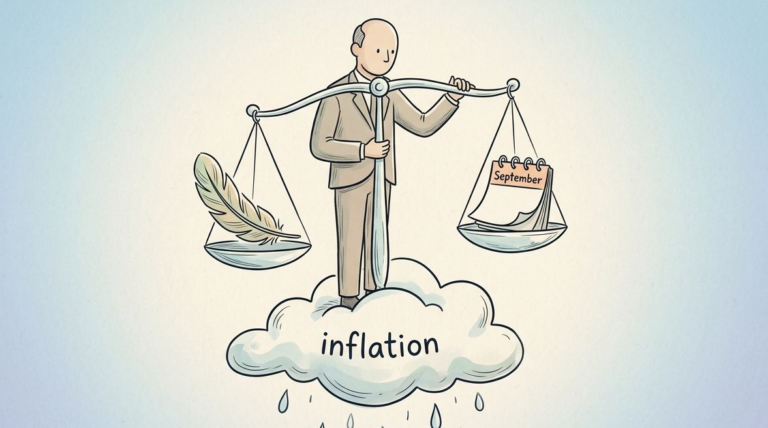
None of which means the calm is guaranteed to last. Markets are weighing a genuine tug-of-war: cooling inflation on one side, a war-driven oil spike on the other, and they’re currently split almost evenly on whether the Federal Reserve will feel forced to help raise rates again in September to keep prices in check. This is the rare moment when a foreign conflict and your mortgage rate are quietly holding the same rope.
How I’m reading it
I’ll be honest about my own approach, because it’s earned through mistakes: I don’t let a frightening headline make my decisions for me. War coverage is built to grip you by the collar; that’s its job, and gripped people tend to act rashly with money, usually at the worst possible moment. The disciplined move is to understand the mechanism (strait, oil, inflation, rates) rather than react to the drama. Understanding the plumbing makes the flood a lot less frightening.
What I won’t do here is tell you where oil goes next, or how to position for it, partly because anyone claiming certainty in a live conflict is selling something, and partly because that forward reading, done properly, is the work I reserve for The Intelligence Forecast, where there’s room to weigh the scenarios rather than shout a guess.
For now, the useful takeaway is simpler. A war you are not fighting is already reaching into your wallet through oil prices, and knowing exactly how it does that is the difference between watching the news anxiously and reading it clearly. If you’d like to keep building that kind of clarity, the free resources in The Collection are a good next step. This isn’t financial advice; it’s just how I’m reading a noisy week, offered in case it steadies yours.