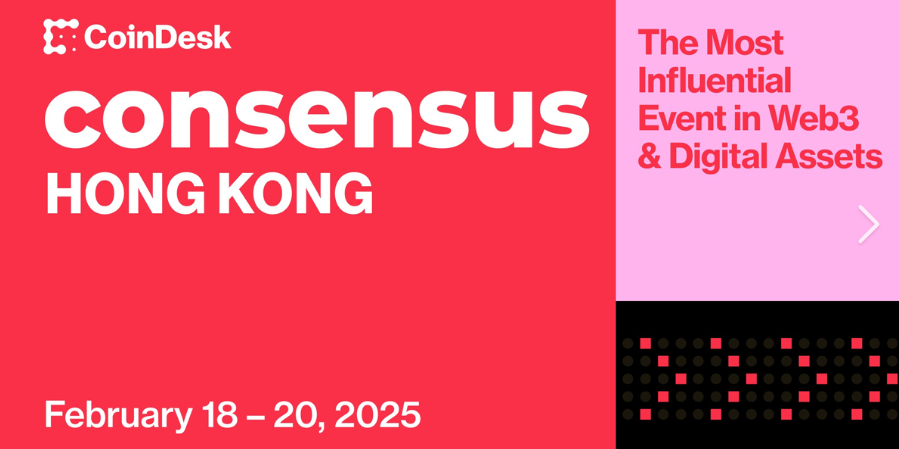
February 18–20, 2025 · Hong Kong Convention & Exhibition Centre
Here is a fact I find quite astonishing, and it is the key to this entire event. Trading cryptocurrency is banned on the Chinese mainland. It is licensed, regulated and actively courted in Hong Kong — a city that is part of China. Somewhere in the gap between those two sentences sits a harbour, a convention centre, and roughly ten thousand people who flew a very long way to stand in it.
CoinDesk’s Consensus, the industry’s grandest old conference, went to Asia for the first time in 2025, in Hong Kong. Of all the decisions made in crypto that year, I thought that one was the most revealing.
The room, and the arithmetic
The debut sold out: getting on for ten thousand attendees drawn from a hundred and two countries. The organisers proudly noted that the assets under management represented in the building came to something north of four trillion dollars, which is the sort of statistic that sounds tremendously impressive until you consider that it is essentially adding up everyone’s employer and hoping nobody asks follow-up questions. Still, the point survives the arithmetic. The suits came, and they came in numbers.
Richard Teng, who runs Binance, gave a keynote on institutional participation and the industry’s endless yearning for regulatory clarity. Around him: executives from Robinhood, OKX, the Solana Foundation, Animoca Brands, and Brevan Howard’s digital arm. And, threaded through the whole programme, Hong Kong’s own regulators, who were not there as observers.
A port between two systems
To understand why Hong Kong, you have to understand what Hong Kong has always been.
Economists have a word for a city like this: an entrepôt. It is a port that grows rich not by making anything but by standing between others who wish to trade and cannot easily do so directly. Goods arrive, are stored, and are re-exported. Value accrues to the doorway. Hong Kong has played that role since 1841, when it was little more than a rocky harbour with excellent instincts, and its entire prosperity has rested on a single peculiar advantage: it sits between two systems that do not quite fit together.
Which is precisely what happened in 2025, only with tokens rather than tea. The mainland’s prohibition and Hong Kong’s licensing regime are not a contradiction to be resolved — they are a design. Capital that cannot easily meet Western protocols directly can meet them in a harbour. Whether you find that arrangement ingenious or precarious rather depends on your temperament, and reasonable people land in different places. What is not in question is that the doorway is doing extremely brisk business.
What the regulators announced
The substantive news came from the Securities and Futures Commission, which used the week to set out a roadmap for the city’s digital asset market — including plans to permit crypto derivatives trading and margin financing for professional investors.
Let me unpack that, because it matters and the language is designed to slide past you. A derivative is a contract whose value depends on something else — you can bet on Bitcoin’s price without ever holding a Bitcoin. Margin financing means borrowing money to make a larger bet. Together, they are leveraging the machine that turns modest gains into thrilling ones and modest losses into catastrophes.
I want to be careful here because I have opinions, not advice. Professional markets need these instruments; hedging risk is a legitimate and necessary business, and a market without derivatives is a market where nobody can insure themselves. And yet October 2025 arrived a few months later, demonstrating roughly 19 billion dollars in forced liquidations, exactly what happens when leverage builds quietly and then unwinds all at once. That the SFC restricted this to professional investors strikes me as the single most sensible sentence in the entire announcement. I hold no view on whether you should ever go near such things. I note that I don’t, and that knowing exactly what you own has saved me more money than any clever trade ever made me.
East meets west, and needs it
The theme everyone kept circling was convergence, not the vague conference sort. The observation was concrete: Asian capital and Western protocols increasingly need one another. Most of the significant blockchains were built by Western developers. A very great deal of the world’s mobile-first, digitally native, enthusiastic user base is in Asia. Neither half is much use without the other.
You could see it in the week’s own news. Monad, a new blockchain promising very high speed while remaining compatible with Ethereum’s software, launched its public testnet — a trial version, open to all, where things are meant to break during the conference. Built largely in the West, launched, deliberately, in the East. Nobody had to explain the symbolism.
How I read it
I came away thinking about doorways. The interesting places in any system are rarely the rooms; they are the thresholds between rooms, where two sets of rules meet, and somebody must decide what passes through. Hong Kong has spent a hundred and eighty years being one, and it is doing it again, with a technology that would have baffled every previous generation of the harbour’s traders.
Is that a signal to do anything? Not remotely, and I’d be wary of anyone who says otherwise. Doorways can close. Rules change with the weather, and this particular doorway sits within a jurisdiction whose future arrangements are contested by serious people on all sides. What I take from a week like this is narrower and, I think, more durable: watch where the serious money chooses to stand, notice when a regulator gives leverage to professionals and withholds it from everybody else, and understand a thing thoroughly before you go anywhere near it. Then make your own decisions slowly, with sums you can afford to be patient with.
This is me thinking out loud in your company — a read on the room, not a political opinion and not financial advice. What you make of a doorway is entirely your own affair.
The Jacqueline Brand — knowledge builds confidence, and confidence builds wealth. This is editorial commentary for information and education only. It is not financial, investment or professional advice, and nothing here is a recommendation to buy or sell any investment. The Jacqueline Brand is not authorised or regulated by the Financial Conduct Authority. The value of investments can fall as well as rise, and past performance is not a guide to future returns. Figures were correct at the time of publication. Always do your own research and consider speaking to a regulated adviser. Where cryptoassets are discussed, they are high risk and largely unregulated in the UK, and you could lose all the money you invest. The Collection
© 2026 TheJacquelineBrand. All rights reserved. Please do not reproduce or republish without written permission.